

Not everyone walking into a car lot has perfect credit, and that’s exactly where in house vehicle finance comes in. Instead of sending your application off to a bank, the dealership itself becomes the lender. It sounds simple, and in some ways it is, but there’s a lot more to know before you sign anything. Let’s break it down in plain terms.

What In House Car Financing Actually Means
In house financing, sometimes written as inhouse car finance, means the dealership itself lends you the money to buy the car. Investopedia defines it as a setup where there’s no bank or credit union involved at all. The dealership checks your ability to pay, sets the terms, and collects your payments directly.
This is often called buy here pay here, or BHPH for short, because you literally buy the car and pay for it in the same place. It’s a completely different setup from traditional financing, where the dealer just helps connect you to an outside lender.
Why People Search for In House Finance Dealerships Near Me
Most people looking up in house finance dealership near me are dealing with one specific problem: their credit isn’t strong enough for a traditional auto loan. Maybe they’ve had a bankruptcy, missed payments in the past, or simply never built up much credit history.
In house dealerships often skip the strict credit checks that banks require. Instead, they look at things like your income and your ability to make regular payments. That’s a real advantage if you’ve been turned down elsewhere.
But easier approval almost always comes with a tradeoff, and that tradeoff is worth understanding before you commit.
In House Financing vs Traditional Financing
Here’s a side by side look at how these two options actually compare, since a lot of the confusion around what is in house financing comes down to not seeing the differences laid out clearly.
| In House Financing | Traditional Financing | |
| Who lends the money | The dealership itself | A bank, credit union, or online lender |
| Credit check | Often minimal or none | Usually required, affects your rate |
| Interest rates | Often much higher | Generally lower, especially with good credit |
| Payment schedule | Sometimes weekly or biweekly | Usually monthly |
| Credit reporting | Often not reported to credit bureaus | Almost always reported |
| Approval speed | Very fast, sometimes same day | Can take longer, especially through banks |
That last row about credit reporting is one people often miss. If a dealership doesn’t report your payments to the credit bureaus, making on time payments won’t actually help improve your credit score.
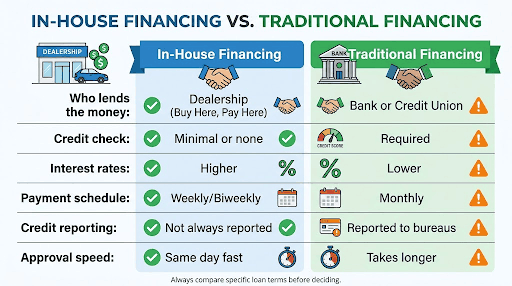
Alt text: “in house car financing vs traditional financing comparison”
The Real Cost of In House Car Finance
This is the part that catches a lot of buyers off guard. According to the Federal Reserve’s research on buy here pay here lending, buy here pay here dealers charge higher interest rates and use more aggressive repayment schedules, often weekly, specifically because their customers are considered higher risk borrowers.
Some in house financing dealerships still charge annual percentage rates above 25 percent. Compare that to the broader market, where the average used car loan interest rate sits around 11 percent according to LendingTree’s latest auto loan data. That gap adds up fast over the life of a loan.
The Federal Reserve also found something worth knowing. Buy here pay here dealers repossess vehicles far more often than traditional lenders do, partly because of how tight the repayment schedules are. Miss a couple of weekly payments, and you could lose the car much faster than you’d expect with a normal monthly auto loan.
Is In House Financing Right for You
In house vehicle finance genuinely helps some people. If your credit is in rough shape and you need a reliable car to get to work, it might be your only realistic option right now. There’s nothing wrong with using it as a stepping stone.
That said, here are a few questions worth asking before you sign anything:
- Does the dealership report payments to any credit bureau?
- What happens if you’re late on a payment, even by a day or two?
- Is there a GPS tracker or remote shutoff device installed in the car?
- What’s the total cost of the loan, not just the weekly or monthly payment?
- Is there a warranty, or are you buying the car completely as is?
If a dealer can’t answer these clearly, that’s worth paying attention to on its own.
Digital Approvals Are Changing How In House Financing Works
One genuine shift happening in 2026 is how fast this process has become. More in house finance dealerships now offer online pre approval before you even step onto the lot, along with mobile apps for making weekly or biweekly payments.
Some dealers are also starting to offer more flexible repayment schedules, letting buyers choose terms that better fit their paycheck timing. This doesn’t erase the higher costs involved, but it does make the day to day experience less painful than it used to be.
What Real Buyers Say About In House Financing
It’s not just industry data worth looking at here. On a Reddit thread in r/UsedCars, buyers openly discussed their actual experiences with in house financing, and the reactions were mixed. Some said it helped them rebuild credit after a rough patch, while others warned about high markups on the car’s price itself, not just the interest rate.
That mix of opinions is honestly the most accurate way to think about this option. It’s not automatically good or bad. It depends heavily on your specific situation and which dealership you’re working with.
Frequently Asked Questions
What is in house financing exactly?
It means the car dealership itself lends you the money for the vehicle, instead of a bank or credit union handling the loan.
Is in house car financing bad for your credit?
Not necessarily bad, but it often doesn’t help either. Many in house dealers don’t report payments to credit bureaus, so your on time payments may not boost your score.
Why do in house financing car dealers charge higher interest rates?
Because they take on borrowers who often can’t qualify for traditional loans, so dealers charge more to offset the added risk of missed payments.
Can I find in house financing dealerships near me with good terms?
Yes, but it takes comparison. Not every in house dealer charges sky high rates, so it’s worth checking a few and asking direct questions about total cost and credit reporting.
Is in house car finance the same as buy here pay here?
Yes, these terms are typically used to describe the exact same setup, where the dealership itself acts as the lender.
Final Thoughts
In house vehicle finance can be a real lifeline if your credit has kept you out of traditional auto loans, but it’s not a decision to rush into. Understanding how the rates, payment schedules, and credit reporting actually work puts you in a much stronger position before you sign. Ask the right questions, compare a few options, and you’ll walk away with a deal that actually fits your situation instead of one that just fits the dealer’s bottom line.