

Alt: A “VOTE” yard sign on a lawn, one of the most common political posters.
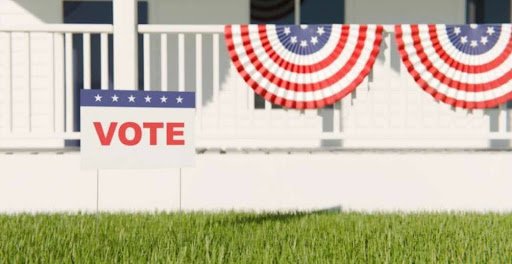
Political posters are printed or digital signs that sell a candidate, a cause or an idea to voters. They work by repeating a name in public, again and again. In 2026, House and Senate candidates have spent more than $20 million on promo items and signs, based on one trade analysis of FEC filings.
Election Day was yesterday, November 3, so the clean up clocks have started. Some yard signs must come down in about a week. Others can stay a month. And pulling down someone else’s sign can end in a criminal charge. Let’s sort out how political posters work, where the rules bite, and what research says about whether they win votes.
What Are Political Posters, and What Do People Call Them?
Most people say campaign posters, yard signs or lawn signs. Museums and history books often use the word propaganda for older, government made pieces. The word only means a message built to persuade. It doesn’t mean the message is false.
You’ll see a few main types:
- Yard signs that stake into a lawn
- Window posters taped inside a home or shop
- Banners and flyers for rallies and events
- Digital posters shared on social media
The same pieces show up in history too. Searches for antique political posters, civil rights political posters and political propaganda posters all point to the same idea: a simple picture and a short line that stick in your head.
Famous Political Posters That Shaped American Politics
Two pieces explain a lot about how political posters spread. The first is a wartime classic. The second jumped from paper to the internet.
| Poster | Year | What the record shows |
| “I Want YOU for U.S. Army,” by James Montgomery Flagg | 1917 | The Library of Congress says more than four million copies were printed between 1917 and 1918. The image first ran on a magazine cover on July 6, 1916, under the title “What Are You Doing for Preparedness?” |
| Barack Obama “Hope” portrait, by Shepard Fairey | 2008 | The Smithsonian’s National Portrait Gallery says the campaign sold 50,000 official posters, groups handed out hundreds of thousands of stickers, and a free download was copied countless times. |
Flagg himself called his Uncle Sam image “the most famous poster in the world,” according to the Library of Congress. That’s a big claim, but four million copies back it up.
Let’s do the math. Four million copies over two years is about 167,000 a month, or roughly 5,500 a day. That’s an estimate that assumes the printing ran evenly over 24 months. If the run was shorter, the daily pace was even faster.
The 2008 piece teaches a different lesson. Fairey meant it to go viral online, and it did. That’s the bridge between paper political posters and the digital ones we scroll past today.
Why Political Posters Still Matter in 2026
Campaigns still buy a lot of signs. A Counselor analysis, published by ASI Central on October 29, 2026, looked at FEC filings from House and Senate candidates. Here’s what it found.
| Item | Figure reported |
| Spending on promo items and signage | More than $20 million |
| Through June 30 | About $17.7 million |
| Added from July 1 to Sept. 30 (top 15 spenders in each chamber) | $3.1 million |
| Yard signs and other signage | More than $7 million |
| Top Senate spender (Democrat James Talarico) | About $2.6 million |
| Top House spender (Anthony Constantino, R, NY 21) | Close to $800,000 |
Do the division: $7 million out of $20 million is about 35%. So roughly a third of that promo money went to signs. Both numbers are “more than” figures, so treat 35% as a ballpark.
There are limits. The analysis counts only candidate committees, not PACs or outside groups. The FEC has no standard category for merchandise, so the totals are estimates. And the report doesn’t single out posters.
Do Political Posters Actually Win Votes?
Not by themselves. A study called “The Effects of Lawn Signs on Vote Outcomes: Results from Four Randomized Field Experiments,” in the journal Electoral Studies, found a small increase in vote share. A Maine Wire report on June 8, 2026 said that bump is too small to save a weak campaign, though it could matter in a close race.
| Pros | Cons |
| Builds name recognition fast | The vote boost is small |
| Shows a candidate has local support | Strict rules on where and when signs can go up |
| Easy for volunteers to place | Removal deadlines and fines if you miss them |
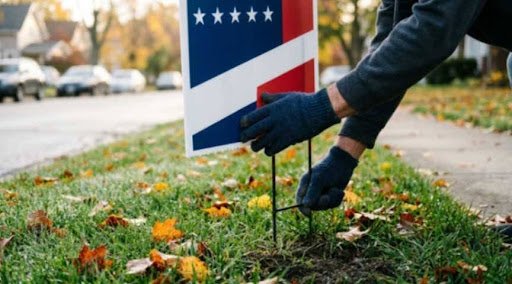
Political Posters and the Law: 3 Rules That Trip People Up
Rule 1: The “Paid for by” box
For U.S. House and Senate candidates, yard signs need a “Paid for by” line in a readable text box, based on FEC rules. States add their own rules too. In Arizona, a KJZZ segment on September 30, 2026 explained that state law requires the paid for disclosure to take up 10% of the sign, according to TJ L’Heureux of the Arizona Agenda.
That segment looked at “Democrats for Biggs” signs. It said no organized group of Democrats backs Andy Biggs, and that the Arizona Republic reported Turning Point PAC pays for them. A complaint is pending over whether the disclosures are big enough. The complaint is about size, not about whether the signs mislead. You can hear the full story on KJZZ.
Rule 2: Your yard is protected speech
Can a city ban political posters from your front yard? Mostly no. In 1994, the Supreme Court decided City of Ladue v. Gilleo. Margaret Gilleo had put a 24 by 36 inch sign on her lawn that read “Say No to War in the Persian Gulf, Call Congress Now.” The city banned nearly all signs on homes. The Court unanimously ruled the ordinance violated her free speech rights, in an opinion by Justice John Paul Stevens. You can read the decision at Cornell’s Legal Information Institute.
Rule 3: Public property is a different story
One sign company’s state guide says signs on medians, sidewalk strips and highway shoulders are almost always banned. Georgia’s transportation department removes them and holds them 30 days before destroying them. In Texas, the state removes them without notice and bills the campaign. Always confirm with your local election office, because city rules vary.
Is It Illegal to Take Down Political Posters?
Yes, if the sign sits on someone’s property and isn’t yours. A Bellingham Herald report, republished by The Spokesman-Review, cites Washington law that makes removing or defacing lawfully placed political advertising a misdemeanor. It says each sign counts as a separate violation, with up to 90 days and a fine of up to $1,000.
A fact check from KCEN says removing a political sign is usually a misdemeanor in all 50 states, citing FindLaw. It adds that it’s not a federal crime, despite viral claims. Arizona has its own window: removing or covering a candidate’s sign is a misdemeanor from 71 days before Election Day through 15 days after.
So here’s the simple version.
| Situation | What usually applies |
| Taking down a sign from a neighbor’s yard | Likely a misdemeanor, maybe trespassing too |
| Taking down your own sign | Fine |
| Removing a sign on public land | Leave it to the city or state |
| Signs left up too long | Can be treated as abandoned and removed |
When Do Political Posters Have to Come Down?
Election Day was November 3, 2026. Here’s what the clock looks like in a few states, using one sign company’s state guide. These dates count forward from that day, so check your city.
| State | Removal window | Counting from Nov. 3 |
| Georgia | 7 to 10 days | Nov. 10 to Nov. 13 |
| Michigan | 10 days | Nov. 13 |
| Texas | 10 days | Nov. 13 |
| Ohio | 14 days | Nov. 17 |
| Arizona | 15 days | Nov. 18 |
| Florida | 30 days (good faith effort) | Dec. 3 |
If you rent, ask your landlord before you put anything up. Homeowners associations can often limit political posters, although some states override that.
How to Print and Make Political Posters
Can you print them at a big box store? Office Depot’s policy came up in a September 2025 dispute at a Michigan store. According to the International Business Times, its print terms say it can decline requests that violate copyright law, or that are illegal or offensive. It also says staff must process lawful, non offensive orders regardless of political or religious content. The company later said the employee involved was no longer with it. Policies can change, so call the store first.
To make your own, follow these steps:
- Pick one message. A name and one short line beat a crowded page.
- Use big, bold type. People read signs from a car.
- Add the “Paid for by” box if you’re running a campaign.
- Check your city’s size and placement rules.
- Plan the clean up before the sign goes up.
Not sure where you fit? Use this quick guide:
- If you’re a candidate, budget for removal and keep your disclaimer large enough.
- If you’re a homeowner, your lawn is protected, but your HOA may have a say.
- If you’re a student, the Library of Congress has historic political posters to study.
- If you’re a voter who dislikes a sign, leave it alone and call election officials if it breaks a rule.
Final Thoughts
Political posters are cheap, loud and everywhere, but they come with real rules. Know the disclaimer, respect other people’s yards and watch the removal date. Do that, and political posters stay a simple way to join the conversation instead of a legal headache.
This article is general information, not legal advice. Check your local election office for rules in your area.
FAQ
Does Office Depot print political posters?
Per its print terms as reported in 2025, Office Depot says it must process lawful, non offensive orders regardless of political content. Call your local store to confirm.
Is it illegal to take down political posters?
Usually yes, if the sign isn’t yours. It’s typically a misdemeanor under state law, and it’s not a federal crime.
What are political posters called?
Campaign posters, yard signs or lawn signs. Older government pieces are often called propaganda posters.
How to create political posters?
Pick one message, use big type, add a “Paid for by” box if you’re a campaign, and check local size and placement rules.
Can political posters go on public property?
Often no. Rights of way, medians and highway shoulders are usually off limits, and agencies may remove signs.