


AI powered homework help means using a chatbot or tutor app to explain problems and check your work. It helps most when the AI gives hints and you do the thinking. Used to copy answers, it can lower test scores, and it can be wrong more often than you’d expect.
More than half of U.S. teens already turn to chatbots for schoolwork. So the real question isn’t whether to use one. It’s how to use it without hurting your grades or breaking your teacher’s rules. Let’s look at what the research says, where these tools slip up, and five simple rules that keep you in control.
How AI Powered Homework Help Actually Works
You type or upload a question. The tool explains it, shows steps, or quizzes you. Some apps take a photo of a worksheet. Others work like a chat with a tutor who never gets tired. People also search for an AI homework helper, an AI question solver and a homework helper app, and they all mean roughly the same thing: software that answers study questions in plain language.
Not all of them behave the same way, and that difference matters a lot.
| Type | What it does | Best for | Main risk |
| Answer solver | Gives the final answer and steps right away | Checking work you already finished | Easy to copy without learning |
| Guided tutor | Asks questions and gives hints | Learning a new skill | Slower, and can feel annoying |
| General chatbot | Answers almost anything in plain language | Explaining ideas, brainstorming | Can sound sure while being wrong |
Khan Academy’s Khanmigo is one example of the guided kind. Its own page says it “challenges you to think critically and solve problems without giving you direct answers.” It’s for students from elementary school through college, and anyone under 18 needs a parent or guardian to add them to the parent’s account.
How Many Students Use AI Powered Homework Help?
A lot. The Pew Research Center surveyed U.S. teens in the fall of 2025 and published the results on February 24, 2026. Here’s the breakdown of how much schoolwork they do with chatbots, based on Pew’s report.
| How much schoolwork with chatbots | Share of teens |
| All or most | 10% |
| Some | 21% |
| A little | 23% |
| Haven’t used them this way | 45% |
Add the first three rows and you get 54%, the share who have used chatbots for schoolwork. Add only the first two and you get 31%, so nearly one teen in three does a real chunk of their work this way.
The survey ran from September 25 to October 9, 2025, with 1,458 U.S. teens and their parents. The margin of error is about 3.3 percentage points.
Pew also asked about cheating. About 59% of teens said students at their school use chatbots to cheat at least somewhat often. Among teens who have used chatbots for schoolwork, 76% said cheating happens at least sometimes. That tells you the line between help and cheating is blurry for a lot of kids.
Does AI Powered Homework Help Improve Grades?
It depends on how you use it. A study from researchers at the University of Pennsylvania tested this with nearly 1,000 high school math students in Turkey. You can read a summary at Wharton Knowledge.
The students were split into three groups:
- GPT Base: A ChatGPT style helper with no safeguards
- GPT Tutor: The same kind of helper, but built to give hints instead of answers
- Control: No AI, just books and notes
During practice, GPT Base students did 48% better than the control group. GPT Tutor students did 127% better. Then the AI was taken away for the exam. GPT Base students scored 17% worse than the control group. GPT Tutor students scored about the same as the control group.
Let’s do the math with a made up example. Say the control group averaged 60 points on the exam. A 17% drop would put the GPT Base group near 50, because 60 times 0.83 is about 50. That’s an assumption, since the percentages are relative, but it shows the pattern: easy practice, weaker memory.
What does that mean for you? The helper that held your hand felt great, but it didn’t leave you with more skill. The one that gave hints at least didn’t hurt. So the style of AI powered homework help you pick matters as much as whether you use it.
| Pros | Cons |
| Explains a tough step in plain words | Can make you lean on it too much |
| Available late at night | Can be wrong without warning |
| Hint style tools can boost practice scores | Easy to cross into cheating |
| Lets shy students ask “dumb” questions | May collect your personal data |

The Accuracy Problem With AI Powered Homework Help
Here’s the part the app store pages skip. AI powered homework help can get math wrong. A 2024 study by Zachary Pardos, a computer scientist at UC Berkeley’s School of Education, and student Shreya Bhandari found that ChatGPT’s methods and answers were wrong about a third of the time. That was reported by The Hechinger Report. It covered an earlier version of ChatGPT, so today’s tools may do better, but the lesson holds.
A quick calculation shows why it matters. If a helper were wrong on one third of a 30 problem worksheet, that’s about 10 bad answers. This assumes your tool has the same error rate as the one in the study, which you can’t know.
The same study tried a trick: ask the same question 10 times and keep the most common answer. Errors on basic high school algebra fell from 25% to 0%. On statistics they fell from 29% to 13%, which the writer still called too high for students.
You don’t need 10 tries. A simple version is to ask the same question twice, in different words, and see if the answers match. If they don’t, check a textbook.
Even the careful tools slip. The Hechinger writer, Jill Barshay, described Khanmigo marking a correct Algebra 2 answer as wrong until she entered it three times. That’s a real example of why you shouldn’t trust a single reply.
What Schools and Rules Say About AI Powered Homework Help
Rules vary by teacher and by district, so check yours first. At the national level, the U.S. Department of Education issued guidance on July 22, 2025 saying federal grant money can support uses like high impact tutoring and instructional materials. “Artificial intelligence has the potential to revolutionize education and support improved outcomes for learners,” said Education Secretary Linda McMahon in the department’s announcement. The guidance also calls for teaching students to use AI appropriately and for involving parents.
Notice what that doesn’t say. It doesn’t say you can turn in AI work as your own. Your teacher’s policy decides that.
Privacy: What Parents Should Know
If you’re under 13, a federal law called COPPA applies. The FTC says services aimed at children under 13, or that know they’re collecting a child’s information, must get verifiable parental consent first. They also have to keep that information only as long as reasonably necessary. That’s from the FTC’s 2012 announcement of the rule update, so check ftc.gov for newer changes.
In plain terms: read the privacy page before you sign up. Don’t share your full name, school or photos of yourself in a homework chat.
5 Rules for Using AI Powered Homework Help Well
Here’s a simple routine you can follow tonight.
- Try the problem first. Spend five minutes on your own, even if you get stuck.
- Ask for a hint, not the answer. Type “give me the first step only.”
- Check the answer twice. Ask again in different words, or use your textbook.
- Follow your teacher’s rule. If it’s unclear, ask before you use AI.
- Protect your data. No full name, school name or photos with faces.
How to Ask So the AI Teaches You
The way you word a question changes what you get back. A lazy prompt gets you an answer to copy. A better prompt gets you a lesson. Here’s a before and after for common homework moments.
| Weak prompt | Better prompt | Why it works |
| “Solve this equation.” | “I got x = 4. Can you check my steps without giving the answer?” | It keeps your work at the center |
| “Write my essay intro.” | “Here’s my intro. What’s unclear to a reader?” | You write, it reviews |
| “What’s the answer to question 7?” | “Explain how to start question 7, one step at a time.” | You still do the solving |
| “Explain photosynthesis.” | “Explain photosynthesis, then quiz me with three questions.” | Quizzing helps memory |
Picture a ninth grader named Sam stuck on a word problem at 9 p.m. Sam’s first move is to paste the question and ask for the answer. It feels fast, but the next day on the quiz, nothing sticks. On the second try, Sam writes out a first step, asks the helper to check it, and gets one hint. It takes ten extra minutes. It also works, because Sam did the thinking. That’s the whole idea behind good AI powered homework help.
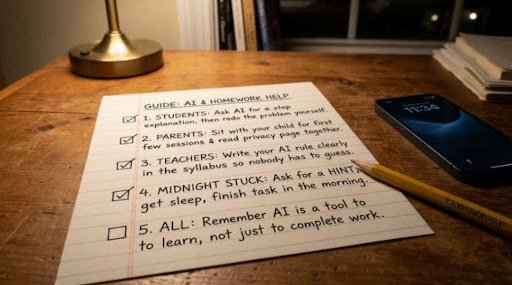
Not sure where you fit? Use this quick guide:
- If you’re a student, use AI to explain a step, then redo the problem yourself.
- If you’re a parent, sit with your child for the first few sessions and read the privacy page together.
- If you’re a teacher, write your AI rule in the syllabus, so nobody has to guess.
- If you’re stuck at midnight, ask for a hint, then sleep, then finish in the morning.
Final Thoughts
AI powered homework help is a good study partner and a poor shortcut. The research points the same way: hints help, copied answers don’t stick. Try the problem first, check what the tool says, and keep your teacher’s rules in mind. Do that, and AI powered homework help can save you time without costing you the learning.
This article is general information, not legal or school advice. Check your school’s policy and the privacy page of any app you use.
FAQ
Is AI powered homework help free?
Some tools have free versions, and some charge. Khanmigo’s page says you must pay monthly or yearly. Always check the limits before you sign up.
Is AI powered homework help cheating?
It depends on your teacher’s rules. Using it to understand a step is usually different from turning in its answer as your own. Ask first.
Can AI solve homework from a picture?
Many apps let you upload a photo or PDF of a worksheet and return steps. Check the work yourself, because these tools can be wrong.
Is an AI homework helper safe for kids?
It can be, with care. In the U.S., COPPA requires parental consent for services that collect information from children under 13. Read the privacy page and share as little as possible.
What is the best AI homework helper app?
There’s no single winner. For AI powered homework help, look for an app that gives hints, shows its steps, explains its privacy rules and lets you check the work.